Quadratic Equations: Formula, Discriminant, and Examples
Gianluca
December 4, 2025
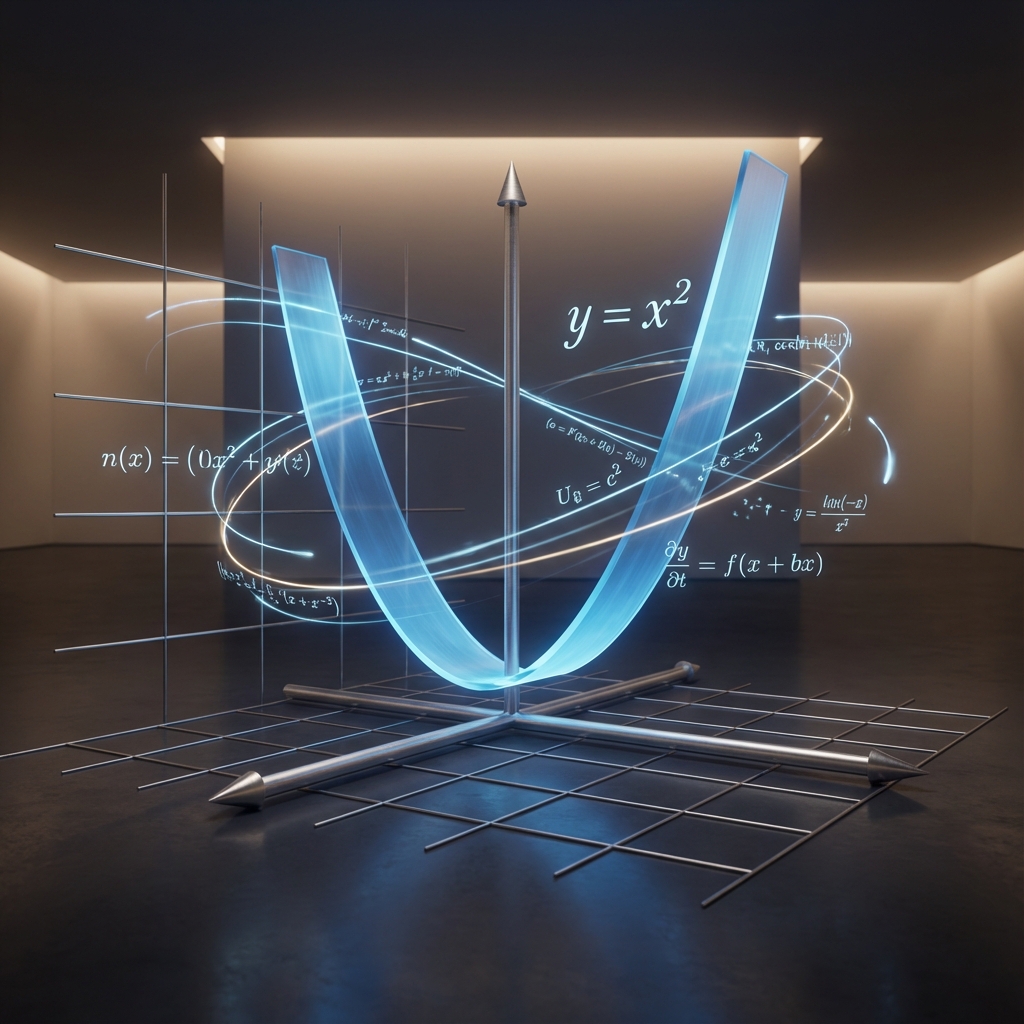
Quadratic equations are a fundamental part of high school Algebra. A mistake in calculating the discriminant can ruin the entire problem.
What is a Quadratic Equation?
A quadratic equation is a polynomial equation where the highest degree of the variable is 2. The standard form is:
$$ax^2 + bx + c = 0$$Where \(a\), \(b\), and \(c\) are real numbers and \(a \neq 0\).
The Quadratic Formula and the Discriminant
To solve any quadratic equation, we use the Quadratic Formula, which relies on the Discriminant (\(\Delta\)).
1. Calculate the Discriminant:
$$\Delta = b^2 - 4ac$$2. Analyze the Roots:
- If \(\Delta > 0\): The equation has two distinct real roots.
- If \(\Delta = 0\): The equation has one real root (a repeated root).
- If \(\Delta < 0\): The equation has no real roots (two complex roots).
3. The Quadratic Formula:
$$x = \frac{-b \pm \sqrt{b^2 - 4ac}}{2a}$$Step-by-Step Example
Let’s solve the equation:
$$x^2 - 5x - 6 = 0$$Step 1: Identify coefficients
- \(a = 1\)
- \(b = -5\)
- \(c = -6\)
Step 2: Calculate the Discriminant
$$\Delta = (-5)^2 - 4(1)(-6)$$$$\Delta = 25 + 24 = 49$$
Since \(\Delta > 0\), we will have two real roots.
Step 3: Apply the Quadratic Formula
$$x = \frac{-(-5) \pm \sqrt{49}}{2(1)}$$$$x = \frac{5 \pm 7}{2}$$
Step 4: Find the solutions
- \(x_1 = \frac{5 - 7}{2} = \frac{-2}{2} = -1\)
- \(x_2 = \frac{5 + 7}{2} = \frac{12}{2} = 6\)
Solution: The roots are \(x = -1\) and \(x = 6\).
The most common mistake isn’t forgetting the formula; it’s messing up the signs inside the square root ($\sqrt{b^2 - 4ac}$).
- The $b^2$ Myth: In our example, $b = -5$. Many students write $-5^2 = -25$. Wrong. In the formula, it is $(-5)^2$, which is ALWAYS positive $25$. Any number squared (real) must be positive.
- The $-4ac$ Flip: Since $c$ is negative ($-6$), the formula becomes $-4 \cdot 1 \cdot (-6)$. That double negative must turn into a plus: $+24$.
Check your math: If you get a negative number inside the square root when you expected a real solution (like $-49$), you likely missed one of these two sign flips.
If you’re struggling to identify a, b, and c correctly, review our guide on Standard Form of Quadratic Equations.
Why reading isn’t enough
Memorizing the formula (\(x = \frac{-b \pm \sqrt{b^2 - 4ac}}{2a}\)) is easy, but applying it correctly under time pressure in exams like the SAT or ACT requires practice. A simple sign error can lead to the wrong answer.
Weekzen allows you to generate infinite quadratic equations (standard, factoring, etc.) and gives you instant feedback. Whether you are in Algebra 1 or preparing for college entrance exams, the app adapts to your level to help you master the material.